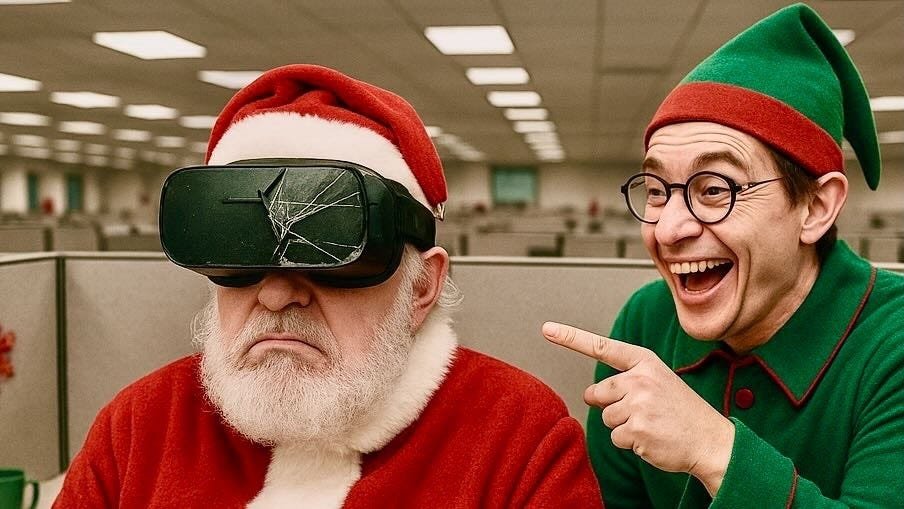
Episode 6: User Experience — “You want me to wear this clunky thing on my head for HOW long?”
Once upon a time a collective hallucination sponsored by the Metaverse Industrial Complex, Enterprise Virtual Reality was going to make employees “immersed, engaged, and empowered.” There were high-fives in pixelated conference rooms, headsets larger than a users’ ambition, and L&D chanting about “transformational learning.” Sadly, the only thing transformed was everyone’s patience.Press enter or click to view image in full sizeSanta experiencing VR-Learning for the 1st time ©2025 Rocinante Research, AI GeneratedThe hype was so blinding, you needed to put on a VR headset to remind yourself it was just hype.Fast-forward to the end of 2025 and Enterprise VR sits exactly where we left it: in the corner, unplugged, gathering dust next to the disinfectant wipes, the “shared headset hygiene policy” binder, and the foam replacements nobody remembers ordering; a relic from the “immersive learning” era. The Metaverse is over, the empathy training avatars retired, and every headset bears the imprint of someone else’s forehead,In previous episodes, we proved Enterprise VR had real value. But then, the swan dive into the bit bucket began and eventually ended up where all bold enterprise ideas go to die. We revealed how hardware manufacturers “went enterprise” by rebranding consumer gear, dissected the painful reality of VR software development, repeatedly died battling the dungeon boss known as Enterprise IT, and most recently unraveled L&D’s tragic descent from educator to corporate compliance enforcer.Unfortunately, we continue our descent into hell where things get personal. Where the demons shove a VR headset on your head, over tighten the strap, and tell you to point the laser beam at the START button, or the “Vomit” button if they are a bit hung over.Forget IT and L&D. This time, our villain isn’t a department, it’s the end user. Specifically, employees who just wanted to survive another workday without motion sickness, cognitive overload, or the trauma of wearing a sweat-soaked headset.Welcome to Episode 6 of Why Enterprise VR Failed: User Experience — “You want me to wear this clunky thing on my head for HOW long?” This episode was created to show that no amount of “immersive engagement” can overcome the universal truth of enterprise technology: if it’s uncomfortable, confusing, or makes you look ridiculous, nobody’s using it twice.This episode is sub-divided into 4 scenes and is sponsored by EvilCorp.WARNING: Prolonged exposure to Enterprise VR may result in motion sickness, headset hair, or deep questioning of corporate priorities. Consult your manager before attempting another “immersive learning experience.” Side effects may include dizziness, nausea, the slow erosion of dignity, and a sudden urge to update your résumé.Scene 1: The Human Factor (a.k.a. Employees Are Not Gamers): Enterprise VR failed by assuming employees would behave like gamers and explores the physical comedy of VR ergonomics.Scene 2: Cognitive Overload: Users weren’t overwhelmed by the virtual world — they were overwhelmed by decoding it. Watching a new VR cohort was like watching preteens on a sugar bender at Chuck E. Cheese after a road trip to Buc-ee’s. After 20 minutes fatigue set in, and by 40 minutes even experienced users crashed and were ready for a firmware update.Scene 3: The Body Revolts: Motion sickness became VR’s unspoken assassin. VR didn’t just overstimulate the senses — it scrambled them. VR triggered motion sickness not through spectacle but through sensory conflict, as the eyes reported movement while the inner ear insisted nothing was happening. Even those who didn’t get sick were left fatigued, disoriented.Scene 4: The Environment and the Ego: Cube farms, conference rooms, and training labs were never designed for VR. Employees felt exposed and ridiculous, unable to see who was watching or recording them. Psychological safety vanished, and headset hair didn’t help; many executives refused to participate the moment they saw what the device did to their dignity. In the end, the environment didn’t fit the tech, the tech didn’t fit the people, and the ego never stood a chance.Scene 1: The Human Factor (a.k.a. Employees Are Not Gamers)Let’s start with the thing everyone avoided saying out loud during a VR Pilot after action review: employees are not gamers. They didn’t grow up running around digital battlefields or wielding motion controllers like a Jedi. The only computer games they play come on their phone because enterprise users have more in common with accountants, claims adjusters, logistics coordinators, and supervisors than with PewDiePie and his 110M YouTube subscribers. Their closest brush with “interactive 3D environments” is changing the chart type in PowerPoint.Yet, somehow, the industry decided the best way to “reinvent enterprise training” was to hand users gamer hardware, gamer controllers, gamer UI metaphors, and then act surprised when things didn’t work out as planned.Ergonomics: The weight of the world on your faceEnemy #1: Weight. Early standalone VR headsets like the Pico G2, Quest 1, and HTC VIVE Focus 3 weighed between 1 to 1 ¾ pounds. That’s fine if you’re at home, in a t-shirt, doing 5-minute Beat Saber sessions. It’s a different story in a conference room, wearing glasses, makeup, and a collared shirt, trying to pretend you’re still a serious professional while a plastic brick slowly carves a groove into your forehead.But it wasn’t just weight. It was adjusting the headset so the user could see clearly. That could mean adjusting the IPD (Interpupillary Distance), fixing head straps, and cleaning the lenses. Any one of those accelerated discomfort.Research on VR usability with older adults and non-gamers backs up what L&D teams learned the hard way: headset fit, weight, and comfort routinely derail adoption. Even when participants like the concept of VR, studies consistently report facial pressure, heaviness, and physical fatigue — especially among first-time and older users. (LINK)Controllers from the Planet of GamersEnemy #2: Hand controllers. Most enterprise employees have never touched an Xbox or PlayStation controller in their lives — they understand mouse, keyboard, click. What they don’t understand are analog sticks that move you forward in one app, rotate you in another, and do absolutely nothing in the third. Triggers might grab, teleport, confirm, or summon a mysterious menu depending on which vendor shipped this week’s module, while grip buttons must be held “just enough but not too much” or you drop the virtual box, forklift, or hypothetical human you were supposed to rescue.Press enter or click to view image in full sizeSanta Controller, ©2025 Rocinante Research, AI GeneratedUnsurprisingly, usability studies show VR novices burn a disproportionate amount of mental energy just figuring out how to interact — leaving far less capacity for the actual task they were supposed to learn. (LINK)Imagine never holding a controller before.Trainer: “Just squeeze the trigger and teleport.”Learner: “Which trigger?”Trainer: “The left one.”Learner: “My left or your left?”Trainer: “Your left hand.”Learner: “No — which trigger on this controller thingy. I keep pushing one of those buttons and I keep seeing a menu pop up and down.”Trainer: “I’m sorry, pull on the left-hand trigger button with your index finger.”Learner: “What do you mean pull? You mean like shooting a gun?”Trainer: “Yes, like you are shooting a gun. Now teleport.”Learner: “What do you mean teleport?”Now scale all that to a room of 30 trainees. VR’s controller and input schemes turned into a kind of organized chaos — every app demanding its own interface accessed by joysticks, head-tilts, hand gestures, or laser pointers.In other words: before VR can teach you how to do a safety check, it must teach you how to be a low-skill gamer — and many VR Leaders never accounted for that in their budgets.As one Fortune 500 VR Training Lead put it:“That plastic brick on your face doesn’t seem heavy — until you’ve worn it for twenty minutes, at which point the pressure, heat, and sensory confusion start transitioning into mild case of claustrophobia. By the time everyone finally got the headset on, adjusted it so it wasn’t blurry, learned how to hold and use the controllers, and mastered teleportation, they had already burned 20 minutes of the 60-minute session.”Identity Clash: “This Is Not Who I Am at Work”There’s also a deep identity mismatch. The gamer fantasy is, “I get to be someone else.” The enterprise fantasy is, “I get to keep my job.”Press enter or click to view image in full sizeSanta LaReve, ©2025 Rocinante Research, AI GeneratedStudies on VR highlight this repeatedly: people will try VR and often find it enjoyable, but many still perceive it as “a thing for younger people” or “gamers,” not a natural extension of their normal tasks. That perception is even stronger in safety-critical or formal environments: hospitals, warehouses, call centers. (LINK) (LINK) (LINK)You have now asked employees to do two uncomfortable things at once:Perform in a new medium they don’t understand,While being evaluated on training outcomes that affect their career.The result? Defensive posture, hesitancy, and stress — exactly the opposite of what “immersive learning” promised. (LINK)Enterprise VR began with a simple, fatal assumption: that employees would happily behave like gamers if you strapped gamer hardware to their faces. Like most seductive narratives, the research says otherwise. Older adults and non-gamers approach VR with very different expectations, anxieties, and physical tolerances than the 20-something early adopters the technology was designed around.Instead of meeting employees where they were, enterprise VR demanded they become something they weren’t. The pattern was predictable and repeatable: initial curiosity, followed by anxiety handling the device, discomfort wearing it for any length of time, and a reliance on constant staff supervision just to get the headset on, adjusted, and working.Some users adapted and a few skills transferred, but organizational culture, workflows, and expectations trailed the technology by miles — and that gap contributed to stalled adoption.Scene 2: Cognitive OverloadOnce you were able to figure out how to put the headset on, VR didn’t just crank up sensory input — it turned everything into a conscious task. Think about it this way, your brain handles depth, direction, object tracking, balance, and body awareness on autopilot. You don’t think, “Now I will move my hand 13 inches forward and rotate my wrist 20 degrees while opening my hand to grasp the mug.” You just do it.Press enter or click to view image in full sizeMichele After 30 Minutes, ©2025 Rocinante Research, AI GeneratedIn VR, especially in early enterprise apps, the tools necessary to simulate human interactions had yet to be developed and it was necessary for the programmers to build all the steps necessary to do something as simple as picking up a coffee cup. In other words, there was no autopilot and every basic action demanded deliberate thought.Below is a composite of captured statements of first-time enterprise VR users during a training session:Where should I be standing? Which way should I face? What am I supposed to be looking at? Why is everything far away blurry and everything close crystal clear — and why does my nose suddenly itch? Oh, there’s the machine I’m supposed to work on; I’ll just walk over — wait, why is there a grid of red lines in front of me? Oh, that’s a boundary. So, I can’t walk. I must teleport. What exactly is teleporting again? Okay, step back four feet, press something, don’t hit the desk — got it. Hey, now I’ve picked up the forklift and I’m accidentally dragging it around the factory. How do I put it down? Why is it upside down? There’s a bulletin board with nothing on it, and now a low-battery alert floating in my face.At this point, no learning is happening — the brain is simply overheating, desperately trying to keep up with a world that refuses to behave.Cognitive Load: Not Just a BuzzwordCognitive load theory tells us that working memory has a limited capacity; when we overload it with extraneous demands, learning and performance suffer — and you guested it, VR is very good at increasing cognitive load. (LINK)A 2022 motor-learning study compared the same task performed on a monitor versus in Virtual Reality. Participants in VR showed higher cognitive load, and that elevated load was linked to poorer long-term motor memory formation. In plain English: they worked harder mentally but remembered less later. (LINK)Other research on virtual multitasking environments has used eye and head tracking plus physiological signals to predict mental load, working memory strain, and attention. Unsurprisingly, VR scenarios that require managing many simultaneous cues and interactions push cognitive load way up, impacting performance. (LINK)Enterprise VR training routinely engineered cognitive overload: busy 3D environments, floating labels and tools, timers, scores, and branching dialogue piled on all at once.So why were we surprised when trainees emerged mentally deep-fried after twenty minutes?Interpretation Overload: Decoding the WorldThe overload isn’t just “more information.” It’s more interpretation. In VR training, especially early pilots, physics and logic were often… flexible. For example:You could walk through a solid-looking wall but not open a perfectly normal-looking door.You could pick up a virtual forklift with two fingers but somehow couldn’t grab a clipboard without triggering three UI pop-ups.One button made you fly; another spun you in place, and pressing both made your avatar salute whoever wandered into your field of view.Users weren’t overwhelmed by the virtual world itself — they were overwhelmed by decoding it.Academic work on immersive learning warns that when interface demands and environmental cues compete with the actual learning goal, the added “immersion” can backfire. Higher immersion often leads to higher mental effort, and if that effort is spent on navigation and mechanics rather than content, learning outcomes suffer. (LINK)A UI Engineer from a very large consultancy shared,In corporate terms: people left sessions remembering the weird teleport mechanic, not the safety checklist.When the Brain Taps OutHow long can people stay in this hyper-interpretive mode before performance degrades? Research on “Time Matters in VR” shows benefits taper off after a point, with learning outcomes often declining beyond 30–45 minutes, and wide variation between users. (LINK)Other studies and best-practice guidelines for immersive learning recommend shorter, focused VR sessions and caution that fatigue and diminishing returns set in quickly if sessions are too long or cognitively demanding. (LINK)Observing hundreds of VR sessions, one VR Lead summarized it like this:0–10 minutes: “Wow, this is cool!”15–25 minutes: heavy concentration faces, slower responses.25–30 minutes: visible fatigue, more errors, “Wait, what am I supposed to do again?”35 minutes: the thousand-yard stare of someone whose memory cache has crashed.Research on VR session duration offers mixed but sobering guidance. Some work suggests that with high-quality, well-tuned software and experienced users, sessions up to an hour might be tolerable without serious adverse effects (LINK). But that’s the best-case scenario: acclimated users, optimized content, controlled environments.Cognitive overload in VR isn’t some abstract theory problem. It’s the practical reality of asking the brain to parse 3D environments, learn non-intuitive interaction schemes, maintain balance and orientation, track goals and instructions, and remember it all later. Do all of that while a headset compresses your face and a virtual forklift is floating in front of you and blocking your field of view.The research is clear: higher immersion increases mental workload, and if that workload isn’t carefully managed, learning and performance can get worse, not better. Unfortunately, many Enterprise VR pilots ignored that limit. The brain did not.Scene 3: The Body RevoltsIf Scene 2 showed the brain getting overloaded, Scene 3 is when the rest of the body files a formal complaint.Motion sickness— or, in the VR world, cybersickness — became the unspoken assassin of many pilots. Not in a dramatic, everyone-is-puking-on-the-floor way but more like halfway through the session, someone in the back quietly goes pale, takes off the headset, whispers “I’m not feeling great,” and then spends the next 30 minutes staring fixedly at a wall and rethinking their career choices.Press enter or click to view image in full sizeThe VP of Cybersickness, ©2025 Rocinante Research, AI GeneratedCybersickness is often explained by sensory conflict theory: when your eyes and vestibular system (inner ear) disagree about what your body is doing, your brain concludes something has gone very wrong (LINK).Systematic reviews of VR sickness consistently identify visual–vestibular mismatch and motion characteristics (e.g., acceleration cues that don’t match body motion) as major predictors of symptoms like nausea, disorientation, and oculomotor strain. (LINK)A 2025 review of discomfort from head-mounted displays notes that common adverse effects include nausea, dizziness, disorientation, and eye strain, even with modern hardware. Meta-analyses show that current-generation HMDs are better than early ones, but cybersickness hasn’t magically vanished. Symptom intensity has decreased overall, but key problems remain. (LINK)VR used for gaming, that’s annoying. In enterprise training, it’s a logistical and legal nightmare: People bail out of sessions early. Trainers must stop to check on participants. HR starts asking about liability and accommodations. IT starts fielding tickets titled “VR made me sick.”Fatigue and FalloutFor hose users who didn’t get sick, fatigue hit fast. Cybersickness research notes that sub-symptomatic exposure — where people don’t vomit but feel “off” — still degrades attention, working memory, and reaction time. (LINK)That’s exactly what you don’t want in safety, compliance, or skills training.By the end of some enterprise sessions, you had a workforce that was still technically “trained”, but they felt drained, foggy, and less confident than when they started. Sadly, many secretly left resolved to never volunteer for “that VR thing” again.The body had reached its verdict.Scene 4: The Environment and the EgoWe now arrive at the part of the story nobody put in the strategy decks: what happens when you drop VR into real workplaces; cube farms, conference rooms, training labs — places that were never designed for people walking around with a plastic brick on their face.The “Everyone Is Watching Me” ProblemIn theory, VR can create a psychologically safe, private learning bubble. In practice, enterprise headsets were deployed in open offices, shared spaces, and glass-walled conference rooms where coworkers could see everything except what the headset wearer saw.Psychological safety literature is very clear: people learn and perform better when they do not fear embarrassment, judgment, or punishment. (LINK)Open-plan office research, meanwhile, has shown that these environments can increase distraction and reduce perceived privacy, with knock-on effects for stress and well-being. (LINK)Now combine the two:You can’t see who’s around you.Everyone else can see you.You’re wearing a bulky headset that wrecks your hair.This isn’t psychological safety. It’s psychological exposure.Research on head-mounted displays in shared/public spaces notes recurring issues of social acceptability, awkwardness, and virtual isolation of the wearer, as well as the exclusion of co-located others (LINK).Enterprise users felt this instantly. Many executives — especially women, who already face more scrutiny over appearance and professional presence — took one look at themselves in a headset and decided: “Absolutely not.”Audio Chaos and Social Collateral DamageWith no headphones, built-in speakers blasted VR audio into the room: forklifts beeping, alarms sounding, NPCs lecturing about safety protocols. That’s immersive for the trainee — and a productivity bomb for everyone in earshot.Put on headphones, and you solve the noise issue, but then the user becomes fully isolated: users can’t hear coworkers, trainers, or fire alarms. Research on workplace surveillance and psychological strain suggests that environments where people feel monitored but disconnected are particularly stressful and bad for well-being. (LINK)So, you either bother everyone else, or you cut the user off from reality.Headset Hygiene: The Bacteria Side QuestLurking beneath the lack of psychological safety was a more literal kind of gross: shared headset hygiene. VR headsets press foam and plastic against the oiliest, sweatiest parts of the face. In multi-user setups, they’re passed from person to person like shared needles. It does not take an epidemiologist to predict what the research states.Studies sampling shared VR headsets in computer labs and public installations found significant bacterial contamination on facial interfaces — including potentially pathogenic species — especially on foam and rubber surfaces that contact skin. (LINK)Other work has looked at UV-C disinfection systems specifically for VR headsets (Check out Cleanbox), confirming that you can kill a lot of bacteria with the right devices and protocols, but those systems need to be deliberately deployed and maintained (LINK).In many enterprise pilots, hygiene protocols were… aspirational. Normally, a box of alcohol wipes, or maybe foam replacements. Each had benefits and demonstrated good intentions, but most organizations were inconsistent with their execution — mostly due to time constraints. But that didn’t prevent employees from noticing; makeup smudges on foam, sweat marks, or the faint scent of someone else’s shampoo.Whatever fragile enthusiasm existed for “immersive learning” did not survive the phrase, “Wait, who wore this before me?”Ego, Culture, and the Final StrawThe net effect of visibility, noise, hygiene issues, and social awkwardness was a direct hit to ego and workplace culture. Employees didn’t feel like empowered learners; they probably felt like test subjects in a poorly rehearsed piece of corporate performance art.In the end, the problem wasn’t just comfort or usability — it was culture. Headsets were built for immersion — in a consumer’s home — VR engineers didn’t have corporate environments on their bingo card.The environment didn’t fit the tech, and the tech didn’t fit the people. Once ego, dignity, and basic hygiene entered the conversation, adoption collapsed.In the office, in hindsight, Enterprise VR never stood a chance.Closing Thoughts: The Headset Didn’t Kill Enterprise VR — People DidBy the time Enterprise VR reached the end user, the outcome was already sealed. Not because the technology didn’t work, and not because the promise was empty — but because the human experience was treated as an afterthought. Headsets were heavy, controls were alien, interfaces were inconsistent, and environments were hostile. The body protested. The brain overloaded. The office watched as user dignity quietly exited the building.User Experience makes one thing painfully clear: enterprise VR failed at the moment it stopped respecting the user. Employees were asked to become gamers, performers, and beta testers — often all at once — inside spaces never designed for sensory isolation, or shared headgear soaked in someone else’s sweat. Cognitive load replaced learning. Motion sickness replaced confidence. Psychological exposure replaced safety. And enthusiasm, once lost, never came back.This wasn’t a usability problem. It was a trust problem. Training only works when people feel competent, comfortable, and respected (LINK). VR routinely delivered the opposite — asking employees to learn critical skills while decoding a new reality, fighting their own biology, and hoping no one was laughing behind the glass wall of the conference room.And in the workplace, if a tool makes people uncomfortable, confused, or quietly humiliated — even once — no amount of “transformational learning” will convince them to put it back on.The headset came off. And that was the end of the experiment.=-=-=-=-=-=-=-=-=-=-=-Over the last 9 months and 6 episodes, we’ve interrogated key suspects found at the Enterprise VR crime scene. Hardware that showed up in a business suit but was still a gamer at heart. Software that promised platforms and delivered prototypes. IT, Legal, HR, and L&D — each doing exactly what they were incentivized to do, even when it quietly strangled adoption. And finally, User Experience, where all those sins collided with an actual human face.We’ve overturned almost every stone in this sad little archaeological dig. But there is still one suspect hiding in the closet — the many-headed beast that sold the vision, amplified the hype, stitched the narrative together, and convinced enterprises this was THE future.Prepare for Episode 7: VR / Spatial Consultancies — The Rise and Fall of the Metaverse Industrial Complex, as this is where we finally face the hydra; the ecosystem of big consultancies, boutique “innovation studios,” evangelists, and wannabes that took a fragile, immature technology, wrapped it in buzzwords, sold it upstream to executives, and drove it straight into the wall — billing by the hour the entire way.© 2025 Rocinante Research | All Rights Reserved. This document may contain sarcasm, hyperbole, and mild caffeine-induced truths.Published December 22, 2025-=-=-=-=-=-=-=-=-=-=If you liked this article, smash that Like button like it just crashed your $2M “immersive learning pilot” five minutes before the board demo.Got opinions? I want them all. Applause. Screaming into the void. Unhinged theories about how “spatial computing” is just PowerPoint with a concussion. Tell me which Big Four firm sold you a Metaverse roadmap that looked suspiciously like a Mad Libs deck written by someone who’s never met an employee, a headset, or reality. Bonus points if it involved the phrase “change management” and zero plans for disinfecting the foam.If you hated this article, that’s fine too. Just rip your headset off mid-training, whisper “Ready Player None,” and slowly moonwalk away from your desk like a consultant realizing — too late — that their SOW doesn’t cover motion sickness, ego damage, or explaining to Legal why half the department now smells like a shared face gasket.Remember — it could always be worse. You could’ve paid $4,000 for an Apple Vision Pro just to stand in a conference room waving your arms like an over-caffeinated Jedi, desperately trying to convince HR that “No, this is learning,” while your neck files a workers’ comp claim and the Metaverse Industrial Complex sends you an invoice for Phase Two.About the AuthorDaniel Eckert escaped consulting in late 2023 after 29-years spent deep inside enterprise boardrooms, PowerPoint war rooms, and strategy offsites that somehow produced neither strategy nor offsites worth remembering. He survived budget committees, vendor bake-offs, and executive steering meetings that made The Hunger Games look like a team-building exercise.Eight of those years were spent in the Enterprise VR trenches, where he helped design, pilot, debug, defend, and eventually euthanize immersive technology programs held together with hope, caffeine, and duct tape.He also co-authored the now-collectible academic artifact The Effectiveness of Virtual Reality Soft Skills Training in the Enterprise — a project so ambitious it briefly convinced several Fortune 500s that empathy could, in fact, be version-controlled.Daniel is now a Principal at Rocinante Research. Semi-retired from selling the future, he now documents it instead — usually right before it collides with reality, budgets, or basic ergonomics.When not writing snark-laden essays about enterprise delusion, Daniel can be found coaching youth soccer, over-analyzing technology roadmaps, or watching each new AI and spatial computing hype wave promise salvation while quietly checking his notes from the last four times this already happened.More dispatches from the front lines of digital optimism, executive groupthink, and innovation theater can be found on Medium — where the sarcasm is free, but the lessons were expensive.Articles in the “WHY ENTERPRISE VR FAILED” series:
Publicado: 2025-12-22 00:18:00
fonte: medium.com