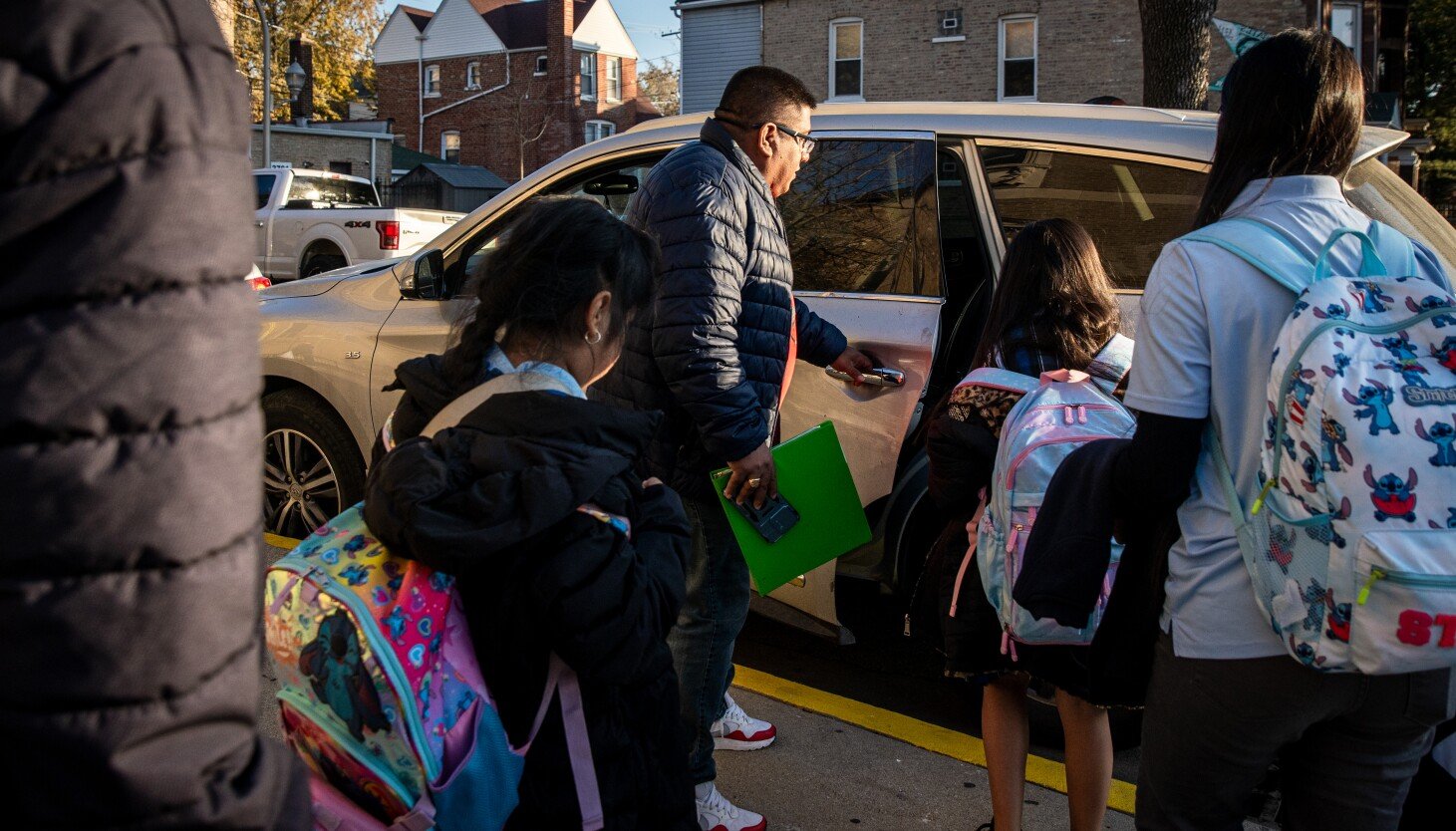
In Little Village, Baltazar Enriquez loads up a van, known as a “magic school bus,” to take children home from school. It’s one of several community-led efforts that sprang up this fall to help children get to and from school safely as immigration enforcement activities intensified in Chicago.
As immigration agents swept Chicago this fall, communities stepped in to get kids to school safely
The streets of Little Village are just waking up when Baltazar Enriquez, with his still-wet black hair slicked back, walks briskly out of his house. He clears papers and a blow horn out of the back seat of his grey SUV before sliding into the driver’s seat.As he drives, his phone is abuzz with messages. Federal immigration agents are moving through the nearby suburbs. They’ve targeted Little Village and were in the area the day before. “They are probably coming here next,” Enriquez concludes.Enriquez pulls up to a brown brick apartment building and dials a phone number.“Buenos días, vengo a recoger a la niña para la escuela.” Enriquez announces he’s there to pick up the girl for school.“Sí,” a man with a gruff voice says. “Un momento.”Soon, a baby-faced 12-year-old in grey sweats gets into the car. She sits quietly in the back seat until Enriquez pulls into the busy drop off line of a local elementary school.Enriquez and the rest of the Little Village Community Council are renowned for blowing whistles to warn of federal immigration agents and for their tense encounters with them. But they also quietly have been taking more than 60 children to and from school every day. “We call ourselves magic school buses,” he says.It’s one of many efforts that sprung up across the city this fall to help get children to school without putting immigrant parents in the path of federal agents.“Operation Midway Blitz” launched in Chicago on Sept. 8, three weeks into the school year. Masked U.S. Border Patrol agents in flak jackets arrived with their confrontational leader, Gregory Bovino. As immigration enforcement intensified, Enriquez, teachers, school board members and others sounded alarms. They worried parents would be too scared to take their children to and from school and that their education would suffer.
WBEZ obtained attendance data from the start of this school year through Nov. 12, the day before Bovino and his agents left Chicago. It spans the entire two months that troops were wreaking havoc in neighborhoods across the city.The data tells a mixed story. It is apparent that fear did keep some students home for days. But also apparent is the steely determination of parents, teenagers, teachers and communities that children should be in school.Most days, attendance rates at majority Latino schools tracked closely with last year’s and mirrored typical weekly ebbs and flows. The attendance rate at predominantly Latino high schools overall dropped from 89% before Midway Blitz to 84% after.But majority Latino and Black schools saw a similar dip in attendance after school had been in session a few weeks last year, suggesting some of the decline may be due to waning student engagement. This comes as schools across the district have struggled to bring their attendance rates back up to pre-pandemic levels.Still, the impact of immigration enforcement can be seen in the data: There were big, unusual drops in attendance rates on particular days, primarily in majority Latino schools, during some of the most aggressive immigration enforcement. But attendance rates appeared to rebound the following week.
Nearly 14,000 students who attend predominantly Latino schools, or about 12% of students, stayed home from school on Sept. 29, the Monday after Border Patrol agents marched through downtown.A few days later, about 14% of students in majority Latino schools stayed home as a rumor spread that U.S. Immigration and Customs Enforcement agents were targeting young people who came to the United States without a parent. Some worried teens could be picked up at random.Schools in individual neighborhoods also saw attendance drop right after particularly heavy days of enforcement activity. On the East Side, for example, armed agents caused a car crash, tear gassed residents and took landscapers and construction workers into custody on Tuesday, Oct. 14. The next day, only about 76% of students showed up at schools in the area, way down from the usual 92% daily attendance rate in the fall.Community efforts offer lifeline to normalcySome school leaders are worried. Principals tell their union, the Chicago Principals & Administrators Association, that they are concerned about declining student attendance this year, and say ICE activity has contributed to a “growing sense of instability” for students. Most border patrol agents are gone for now, but ICE agents are still detaining people in Chicago.Chicago Public Schools officials have told schools they can mark an absence as excused if a child misses class to keep safe from immigration enforcement — a strategy that also means scared immigrant parents will not receive threatening truancy letters. But students still have to make up missed work.Officials also stress that school is the safest place for children and have resisted calls to offer a remote learning option. They have tried to send the message that they are on top of the situation: sending letters to families when federal agents are in the area and keeping kids inside when they are nearby.CPS officials acknowledged in a statement that while districtwide attendance remains generally consistent to prior years, “certain days may reflect sharper dips in attendance among our Latino and English Learner students.” CPS officials note that they did not conduct this analysis, but they are “reviewing these patterns and working with school leaders, families, and community partners to address barriers to attendance and to ensure that all students feel safe and supported at school.”Yet early on, district leadership realized they couldn’t handle the situation alone, says Fanny Diego Alvarez, chief of CPS’ family and community engagement. Alvarez came to CPS about a year and a half ago from a nonprofit in Little Village, and many in the field give her high marks for working tirelessly to support students these past few months.In turn, she credits them.“We’ve seen community-based organizations, parents and volunteers doing more to create additional safe passage for students and for families,” she says. “That’s the ideal in every community … for schools to be an extension of neighborhoods, and neighborhoods to be an extension of schools.”
Darwin Elementary parent Javier Briz helped gather parents and community members to monitor immigration enforcement activity before and after school in Logan Square.Anastasia Busby/For the Sun-Times
Javier Briz, a dad who lives in the Northwest Side neighborhood of Logan Square, has seen that.When he put out a call for volunteers to help his children’s school, Darwin Elementary, some 40 people responded. Many of the volunteers don’t even have children in school. On a recent Friday afternoon a group of mostly white-haired ladies wearing yellow vests and whistles stood watch as the boys and girls scurried home.“It has been an awakening,” Briz says.For parents like Maria in Albany Park, these efforts have meant the difference between sending their children to school and keeping them home.Maria’s husband was detained on his way to work this fall. Now she only feels safe sending her 6-year-old daughter with a “walking school bus” manned by parents and residents from her neighborhood. It’s similar to the magic school buses in Little Village, but on foot.“I’m the only person left for my daughters,” says Maria, who also has an almost 2-year-old. Maria fears deportation, and spoke with us on the condition that we do not use her real name, or identify the name of her daughter’s school.“At any moment they could be left behind,” she says of her little girls. “I’m so afraid to go out on the street, to face that every day. … If something happens to me, who will be there for them?”Maria’s older daughter cries for her dad at night and worries about an injury he got at his construction job, asking over and over about his hurt hand. The kindergartner desperately wants her dad to walk with her to school, like he did for the first few weeks this fall.Still, Maria says her daughter insists on going to class. She tells her mom: “I want to go play with my friends and learn. I want to learn a lot.”“She loves school so much,” Maria says. “She doesn’t miss a single day.”The power of student activismStudent-led efforts have also been a key piece of the puzzle.Lia Sophia Lopez, who is 17, goes to high school in Little Village, where Enriquez works. Seeing so many of her classmates and neighbors from the strong Mexican neighborhood scared and in hiding disturbed her.“I was feeling angry and almost like there was nothing that I could do,” says Lia, who is a senior at Social Justice High School, one of the three small schools in the Little Village-Lawndale multiplex.So Lia planned a walk-out with two classmates that drew hundreds of students out of class. Together they marched through Little Village, chanting: “Say it loud, say it clear, immigrants are welcome here.”“I just remember feeling very happy to know that I was not the only one feeling hopeless and wanting change,” Lia says.Lia says actions like that help her and her classmates feel empowered and inspire them to keep coming to school. The daily attendance rate at Social Justice Academy this fall was, on average, about 5 percentage points less than the same time last year. On some days, dozens of students were absent from school, but many returned the next day.
In Logan Square, Viviana Barajas of Palenque LSNA has helped pass out whistles and stood watch outside of schools for federal immigration agents.Anastasia Busby/For the Sun-Times
Viviana Barajas, the coordinator for school safety for Palenque LSNA, a longtime community organization in Logan Square, has been part of the effort to pass out whistles and monitor the streets for federal immigration agents.Barajas, who hails from a big Mexican family, says even as she’s thankful for the people not connected to the immigrant community helping out, she’s most impressed with the resilience she sees — the parents who make sure their children get to class, the high school students who insist on speaking out for people who can’t, the tamale vendors who refuse to go underground.“I don’t think that they go to school or work because they’re not scared,” Barajas says. “I think that they go to school and they go to work because they still have to. They have to live their lives.”Teachers keep students tethered to schoolSchool staff have also been a powerful force in keeping students engaged in school. They often stand watch during morning drop off and dismissal and connect families with organizations that can deliver food or provide legal help. Some have even come up with ways for students to stay on top of school work from home.At some schools, the neighborhood is not as active, leaving teachers and principals on their own.That’s the case at Nash Elementary, which serves just under 300 students in Austin on the West Side. It’s one of 18 schools that historically had almost all Black students but has seen an influx of Latino English Language Learners.Nash has almost 100 Latino students — 10 times more than the school had a few years ago — and English Language Learners make up almost 30% of the school. In 2019, Nash had none.As far as Nash teacher Sylvelia Pittman knows, there’s no neighborhood group to help usher students to and from school.Yet families are vulnerable there, too. Two mothers of children who attend Nash were detained, leaving their dads scrambling to take care of the family solo.Still, attendance has been steady. Data show, just like last year, average daily attendance this fall was hovering around 90%.Pittman says she and her colleagues have leaned on the Chicago Teachers Union. Their contract requires schools to keep students safe from federal immigration agents. The union has also trained hundreds of teachers and other staff on how to protect students if ICE tries to come into or near the school.Pittman says the school’s small size allows staff to stay in tune with their students. Staff noticed that when parents arrived even five minutes late for pickup, children were visibly distressed.“You could see the worry on their faces, the uncertainty,” she says. Pittman and others talked to the parents and now moms and dads are pulling up on time.More than anything, Pittman says Nash is a place where families can find support. A little boy whose mom is detained often seeks her out for a hug. The school counselor regularly checks in with affected students, and the principal has sent children home with trays of lasagna and other complete dinners for their families.“I believe they keep coming because we show them love,” Pittman says.
At the high school level, several teachers say they are letting students do school work at home if they are afraid to come to class. While students might still be marked absent because the district doesn’t have a remote learning option, the students are facing no other consequences, teachers say.Juarez High School in Pilsen on the Southwest Side, where some of the most intense immigration enforcement activity took place, went even further.When Juarez started to see a dip in attendance, the school devised a plan to support students staying home, says teacher Liz Winfield. On some days, more than 70 teens were on that list.“My principal was very understanding and proactive,” she says. If “there’s ICE activity on your block and you actually shouldn’t leave your house, then ‘here are ways that you can still complete your classwork online.’”Winfield says teachers were encouraged to make online tutorials, explaining step-by-step how to do the work.And the school’s two teachers who work with bilingual students are charged with regularly checking in on students who are staying home. They offer tutoring and ask whether the family needs groceries or mental health support.Many students have been out one week, but then back the next. Average daily attendance at Juarez this fall was 83%, slightly down from last year.“I think a lot of them are worried about being able to pass this school year,” Winfield says. “They’ll email me and say, ‘What do I need to do to make up work? What can I do while I’m at home? I’ll be back next week. What have I missed?’”District officials have insisted that they can’t offer a remote option without the governor declaring a state of emergency. However, some board members and students say the district should at least give some students the option to work from home.Sustained efforts can take a tollThe walking school bus that picks up Maria’s little girl in Albany Park was created after immigration agents detained a mother after school drop off on a sunny October morning.“To have a mom snatched from a bus stop just a couple of blocks from the school is everyone’s nightmare scenario,” says Bridget Murphy, the director of the parent engagement institute for Palenque LSNA, whose children attend the same school as Maria’s daughter.Murphy says many families were in a panic and scared to pick up their kids. That afternoon, parents texted one another and gathered at the school to get students home safely.But the next day, dozens of students missed school, Murphy says. One day in October, the average daily attendance rate dropped to as low as 78%, CPS data show. In August and September, an average of about 94% of students came to school each day.But in the wake of that detention, the community came through. Murphy and others organized the walking school bus that now has 50 volunteers and takes about 90 students to school every day. On top of that, members of the community are helping Maria and other families buy food and pay rent.“It is happening from family to family, and neighbor to neighbor, big kid to little kid,” says Murphy. “It’s just an incredible whole community undertaking.”
Baltazar Enriquez gets constant calls and messages as he monitors for immigration enforcement activity and arranges school pickups and dropoffs for children in Little Village.
A similar outpouring has happened in Little Village, but the round-the-clock work has taken a toll.After three straight months of aggressive immigration enforcement, Enriquez seems a bit bitter.He thinks the school district should have offered remote learning to students who stayed home due to immigration enforcement. At the very least, he’s emphatic that the generic signs that CPS put around schools, saying “employee access only” in parking lots, should be replaced with ones specifically saying that federal agents can’t use them for staging grounds, as called for in an executive order by the mayor. His organization even got signs printed up themselves.At the same time, the president of the Little Village Community Council knows he and his neighbors’ efforts are helping.One moment stands out: Enriquez’ team started transporting a 10-year-old named Juan who hadn’t been in school for three weeks. When Enriquez went to get him at the end of his first day back, the teacher pulled him aside and asked him to inform the little boy’s mom that he had been “obnoxious” all day, talking and playing when he needed to focus on his work.“He had all that energy and he was excited,” Enriquez says. “Can you imagine sitting in the house for three weeks?”As they drove home, Enriquez told the boy he wasn’t going to tell his mom.He wishes the teachers understood that the boy was just thrilled to be at school.Sun-Times reporter Emmanuel Camarillo contributed reporting.
Publicado: 2025-12-02 11:30:00
fonte: chicago.suntimes.com