How USC landed the No. 1 class and relaunched a recruiting powerhouse
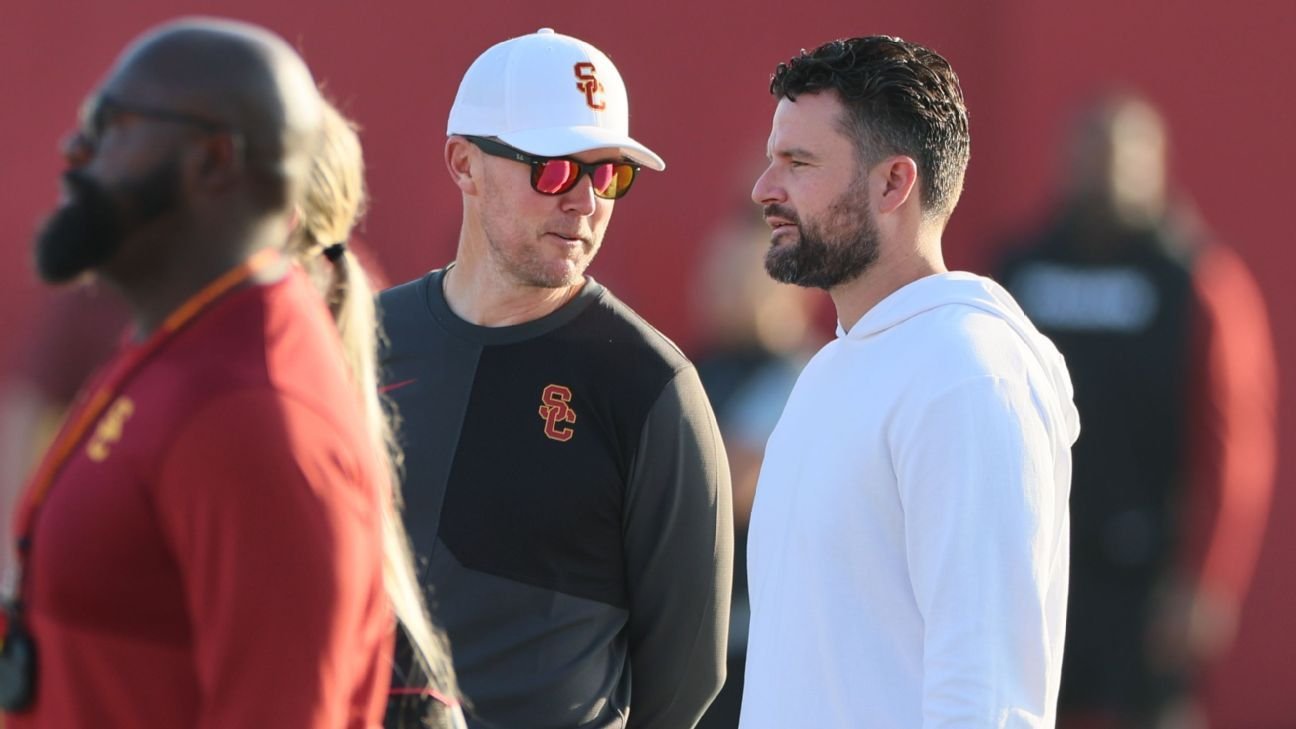
Eli LedermanDec 2, 2025, 08:50 AM ETCloseEli Lederman covers college football and recruiting for ESPN.com. He joined ESPN in 2024 after covering the University of Oklahoma for Sellout Crowd and the Tulsa World.LOS ANGELES — It took Lincoln Riley and Jen Cohen more than nine months to make the hire.In early 2024, USC’s head coach and athletic director set out to find a general manager, eyeing a figure who could modernize the Trojans’ front office operation for college football’s money era.They interviewed a vast pool of candidates, rising personnel stars across both the Power 4 and NFL ranks. Texas Tech general manager James Blanchard turned down the job. So did Alabama’s Courtney Morgan. So Riley and Cohen’s search continued into the fall of 2024, dragging all the way through the program’s 7-6 finish in Riley’s third season in charge.”We probably talked more about that (search) than any other single topic in the years that we’ve been here together,” Riley told ESPN earlier this month. “We both knew how important it was to find the right fit and to equip that person with a great staff.””Our patience has been rewarded,” he added.Editor’s Picks1 RelatedEventually, USC honed in on a brash, intensely energetic 30-year-old with front office pedigree and a grasp of the sport’s evolving landscape: Notre Dame’s Chad Bowden.The son of Jim Bowden, formerly the general manager of the Cincinnati Reds, Bowden was the University of Cincinnati’s director of recruiting when the Bearcats reached the College Football Playoff in 2021. At Notre Dame from 2022 to ’25, he’d successfully overhauled the program’s personnel setup alongside Marcus Freeman and built the roster that played Ohio State for the national championship earlier this year on Jan. 20.Four days later, USC lured Bowden away on a multiyear deal worth upward of $1 million annually, per ESPN sources. In less than a year, he’s constructed one of the nation’s deepest 2026 recruiting classes, restoring the Trojans — for now, at least — as a recruiting juggernaut.”I knew what this place had the potential to be,” Bowden said. “It had the potential to be something historic. There was a dynasty that could be built here.”Indeed, after reshaping its front office, adopting an ultra-aggressive approach to recruiting and taking fresh steps to repair local ties, Bowden, Riley and USC will enter the early signing period Wednesday with ESPN’s No. 1 recruiting class in the 2026 cycle. If that holds, it will mark the Trojans’ first No. 1 class since 2007, reaching back to the peak years of the Pete Carroll era.Lincoln Riley and Chad Bowden (right) have the top 2026 recruiting class. Allen J. Schaben/Los Angeles Times/Getty ImagesAll told, USC is poised to sign 33 prospects this week, including 18 members of the 2026 ESPN 300, headlined by five-stars Keenyi Pepe and Elbert Hill. Notably, the class includes 19 commits from California, just four fewer in-state recruits than the program, somewhat remarkably, signed across its first three full recruiting cycles under Riley combined.The price tag? Industry sources told ESPN that the Trojans’ incoming class will cost them north of $9 million, tied heavily to a string of front-loaded NIL contracts that powered a surge of 21 commitments from Feb. 1 to May 30 before the House settlement took effect in July.Still, questions linger. Can USC’s latest investment — this time in its roster, a revamped front office and one of the faces of college football’s modern personnel movement — be the thing that finally returns it to perennial national contention and puts the Trojans back on top for good?Internally, they believe the program’s star-studded 2026 recruiting class is just the start.”I think everyone wants this place to be great again,” Riley said. “It feels like the stage has been set here and things are in place for a great run. I think we’re just seeing the beginning of that.”BOWDEN SPENT MUCH of his first 90 days as USC general manager navigating L.A. traffic.He drove all over Orange County and the city of Los Angeles to schmooze top university donors. He visited with coaches at local high school powers like Mater Dei and St. John Bosco. From the living rooms of prospective recruits to the sideline of Snoop Dogg’s youth football league, Bowden traversed Southern California with a loud and clear message.”It was just saying, ‘Man, this is how we want to build it,” he told ESPN earlier this month. “California is No. 1 to us. It’s all we care about. We want to take care of the state.”Of all the tasks on Bowden’s plate upon his January arrival, few were more important than this one. To rebuild USC, the program needed to renovate its image locally.Under Carroll from 2001 to ’09, the program set up a proverbial fence around California recruiting. Per ESPN research, 69% of USC’s high school signees came from within the state across the five cycles between 2006 and 2010. In Carroll’s glory years with the Trojans, the best in California stayed home, and USC fueled its winningest run of the 21st century with local talent.All of ESPN. All in one place.Watch your favorite events in the newly enhanced ESPN App. Learn more about what plan is right for you. Sign Up Now
“I was at Long Beach Poly in the early 2000s,” said Mater Dei head coach Raul Lara. “I’ll never forget the way USC’s staff was always at our place. My first year, I had five All-Americans. They ended up signing four of ‘em.”At the time, it would have seemed unfathomable that the Trojans might ever struggle to recruit local pipelines. Yet, in the post-Carroll years, the Trojans’ in-state presence began to slip.The NCAA sanctions that forced Reggie Bush to return his Heisman Trophy shook the program and stripped USC of 30 scholarships in 2010. Three head coaches in six years — Lane Kiffin to Steve Sarkisian to Clay Helton — brought further instability. Years later, USC was slow to adapt to college football’s ever-shifting financial landscape. The school’s initial in-house NIL collective, “BLVD,” folded after nine months. Several other initiatives crashed and burned, too.Multiple high school coaches in the state told ESPN that by the 2020s, as programs such as Alabama, Georgia and Ohio State were upping their recruiting efforts on the West Coast, the Trojans had effectively ceded their control as the region’s preeminent recruiting force.”We felt like other schools did a better job recruiting locally than them,” Mission Viejo coach Chad Johnson said. “It’s like, man, we haven’t seen USC at all. But we’re seeing Oregon here every other damn day.”Riley, at least initially, struggled to find the right approach himself. After arriving from Oklahoma in 2021, he cast a national vision of recruiting as part of his pitch to restore USC. Two years later, Riley stated that the roster he inherited had “players from the state of California that, in my opinion, should not be on the USC roster for one reason or another.””Hiding behind the curtain of ‘Well, at least we’re recruiting California kids’ doesn’t do the program any good,” he told reporters in the fall of 2023.The sentiment irked local programs and recruits. It was starkly reflected in Riley’s early USC classes, too. Since 2006, the Trojans have signed only three classes in which fewer than 50% of the prospects came from California, per ESPN research; each belongs to Riley.Across those three cycles, USC landed only nine of the 73 in-state prospects ranked inside the ESPN 300. Meanwhile, future stars (and California prospects) such as Matayo Uiagalelei (Oregon), Nate Frazier (Georgia) and Dijon Lee Jr. (Alabama) filtered to out-of-state programs. In the 2025 class, Alabama (5), Oregon (4), Washington (4) and Texas A&M (3) all signed as many or more elite prospects from California than Riley and the Trojans (3).”The dynamic has changed a lot,” Sierra Canyon coach Jon Ellinghouse said. “They put their emphasis on the national level for a bit. Then obviously you kind of lose the buzz and you start having down years where you’re not having a ton of success. It all kind of spirals.”Five-star offensive lineman Keenyi Pepe is the top-rated recruit in USC’s 2026 class. UA NextBy the end of the 2024 season, Riley and Cohen were not looking expressly for a general manager to reignite the program’s in-state recruiting presence. But as USC reconfigured its top-down alignment and organized fresh financial backing for the program, the timing of Bowden’s arrival was perfect, coinciding with the deepest class of California talent since 2019.The Trojans’ in-state push in the 2026 class began almost immediately as Bowden drove all over Southern California in early 2025. In a short time, the program was hoovering local talent; from March 1 to June 1, USC landed commitments from 10 in-state prospects.Emmett Mosley, the father of four-star USC wide receiver pledge Trent Mosley, picked up on the shift instantly. His older son, Emmett Mosley V, was a three-star recruit in the 2024 class. Overlooked by the Trojans at the time, he landed at Stanford, then transferred to Texas in 2025.Trent Mosley had already developed a close relationship with Bowden at Notre Dame. He committed to USC in March, less than two months after Bowden joined the program.”From kid to kid, it was an entirely different approach when Chad kind of came on board at USC,” the elder Mosley said. “He’s built a bond with our family. It’s genuine.”On Wednesday, the Trojans will sign eight of California’s 31 top 300 recruits in the 2026 cycle, nearly as many as they signed from 2023 to ’25. Altogether, at the end of Bowden’s first cycle at USC, the Trojans are set to pull more California prospects — 19 — than in any class since 2011.”Chad brought the energy,” said Russell Redeaux, father of four-star running back pledge Deshonne Redeaux. “Everything with USC had kind of been a wait-and-see approach. Chad grabbed the bull by the horns. I think a lot of us here in California could appreciate that.”JONAS WILLIAMS WAS still publicly committed to Oregon when he visited USC in early February.ESPN’s No. 3 dual-threat quarterback had already grown comfortable with Riley across their several-times-a-week phone calls. But sitting across from the Trojans’ coach in Riley’s office, Williams recalled feeling genuinely startled when a loud ball of energy burst through the door.”Chad was like, ‘What up, fam?’ And I’m like, ‘What’s up?'” Williams said. “But then he introduced himself and was just a down-to-earth guy. You kind of just get along with him because he has this young spirit. Quite honestly, I don’t know his age.”Four-star QB Jonas Williams is one of 18 ESPN 300 players in USC’s class. AP Photo/Tony GutierrezWilliams flipped his commitment to USC three weeks later. He’s part of an army of USC commits that considers Bowden’s vigorous, up-front approach one of the keys to how the Trojans secured the nation’s top 2026 class. Talanoa Ili, ESPN’s No. 6 outside linebacker, said his phone didn’t stop buzzing with texts from Bowden until he committed to the Trojans in June. Bowden was even more forward in his efforts with four-star offensive guard Breck Kolojay.”He called and basically told me, ‘I’m drafting you,'” said Kolojay, who picked USC over Georgia and Miami in July. “That’s what he said. He’s like, ‘I’m drafting you. You’re not going to have to make a decision.’ I laughed when he said that. But I realized quickly that this dude’s a bad MFer.”High school coaches across the state point out a renewed confidence from USC since Bowden’s arrival. Several also note Bowden’s straightforward honesty. “Chad’s a straight-up guy,” said St. John Bosco’s Jason Negro. “He’s identified their shortcomings and he’s going out and trying to address them pretty aggressively.” The same qualities helped Bowden jell with Riley, too.”We’re both pretty blunt,” Riley explained. “Sometimes you feel like you’ve worked with somebody longer than you actually have. And that’s happened, I think, pretty quick.”Bowden has brandished a reputation as Swiss Army knife in recruiting: a gifted relationship builder, an honest negotiator and a motivator willing to do most anything to secure a win.At Notre Dame, he once dressed as a leprechaun to welcome recruits. In another, more infamous instance, Bowden was kicked out of the South Bend airport for blaring music from a boom box as recruits reached baggage claim.Bowden credits the seemingly instant success to the front office staff he’s assembled at USC.Director of recruiting operations Zaire Turner and recruiting analyst Logan Snead — son of Los Angeles Rams GM Les Senad — followed from Notre Dame. Assistant general manager Drew Brown (Illinois) and director of player personnel Max Steinecker (Wisconsin) quickly joined last winter, as well. Bowden also retained a number of previous USC personnel staffers, including Aaron Amaama, Skylar Phan and Weston Zernechel, who remain central figures in what is easily one of the deepest and best resourced personnel departments in all of college football.”We’ve got the best front office staff in America,” Bowden said. “The whole operation is NFL.”Elbert Hill is the top-ranked cornerback in the 2026 class. Under ArmourBowden and his operation are ultimately part of why Mater Dei tight end Mark Bowman pulled a 180-degree turn on USC and landed in the Trojans’ 2026 class in May. In fact, months earlier, late in the 2024 season, ESPN’s No. 29 overall prospect nearly bailed on visiting the program entirely.”Frankly, we had to drag him to that game,” Bowman’s father, Kirk, said. “He didn’t have a lot of interest. Once Chad got into place, everything changed for us.”By the time Bowden arrived in January, Bowman counted Georgia, Ole Miss, Oregon and Texas among the leading programs in his recruitment. But Bowden’s pitch was honest and intriguing.He told Bowman and his family that USC would be a good, eight- to nine-win team in 2025, but that he didn’t expect the Trojans’ rebuild to reach its full potential until 2026 or 2027. Over the next few months, Bowden impressed upon the Bowmans how integral their son was to that vision.Bowman committed to USC in May, swayed by the blend of optimism and realism. Before the Trojans’ Nov. 15 win over Iowa, his father found Bowden on the sideline and pulled him aside.”I said, ‘Chad, everything that you’ve told us is coming true,'” Kirk Bowman recalled. “There’s a level of reassurance with that as a parent. Like, ‘This guy had a vision and it’s really happening here.'”THERE ARE SIGNS of progress everywhere around USC. The program’s ability to secure the nation’s No. 1 recruiting class, but also to maintain it over the past six months, is just one of them.The Trojans closed the regular season over the weekend at 9-3, a step forward after the program’s 2023 regression. Financially, under the alignment of Cohen, Riley and Bowden, USC is well-positioned to continue its momentum in the talent acquisition space. Next summer, the program will move into a brand new, state-of-the-art, $200-plus million performance center.To Bowden, it’s everything Cohen sold him on when he came to USC.”The only reason why we have what we’ve been able to accomplish this whole year is because of Jen Cohen’s vision,” Bowden said. “It’s exactly why I chose to go from Notre Dame to USC, because Jen’s vision for this program was to win. It was to be as aggressive as anybody. It was to have the proper alignment and structure in every area of the program.”Riley and Jahkeem Stewart, last year’s top recruit, were in the College Football Playoff picture for part of the season. Kirby Lee/Imagn ImagesCrucially, under Bowden’s leadership, the Trojans were among a collection of Power 4 programs to take advantage of the pre-revenue sharing market this spring, investing heavily in front-loaded deals for players before the spending cap kicked in with the House Settlement on July 1.”Just like everyone across the country,” Bowden said.Many programs offered front-loaded contracts to retain existing players on their rosters and new additions in the transfer portal windows. According to ESPN sources, few programs, if any, have been more aggressive with such deals in the 2026 high school class than USC, which secured 30 of its 33 commitments in the 2026 cycle prior to July 1.Industry sources told ESPN that USC began doling out payments to committed recruits through collective deals earlier this year, paying out a portion of a given contract early in order to minimize the cap hit when they land on campus. Per ESPN sources, Bowman, the Trojans’ fourth-ranked pledge, has already secured the first half of a three-year deal worth seven figures annually.Across the personnel space, USC’s financial strategy and overall approach to roster management in the 2026 cycle class draws a range of responses, from admiration to envy to broad skepticism.”They did a good job of being ahead of the curve,” one Big Ten personnel director told ESPN.”Their administration is being aggressive, and I think they have the cash flow to do it,” an SEC GM said. “They’re betting the rules are not going to be enforced, which is really smart.”By rule, student-athletes are required to disclose all pre-college NIL earnings to the College Sports Commission upon enrollment. However, questions have swirled over the enforcement arm and its oversight ability in the NIL space since its inception earlier this year. Sources within Power 4 programs cast doubt over whether the CSC can fully regulate deals and early payments like the ones USC and other schools have given out this recruiting cycle.A signing class that could ultimately cost more than double the average Power 4 signing class has plenty of detractors, too. “Their high school class has to be close to our entire roster (in terms of cost),” an ACC GM said. Some sources question the value of a potential eight-figure high school class under a revenue share model and in an era of unlimited transfers. Others share doubts over the actual underlying talent of a group that includes as many ESPN 300 commits as any nationally.Bowden has helped bring in a recruiting class with 18 ESPN 300 commits. USC AthleticsThe Trojans have seen plenty of false dawns over the past decade and a half. Riley, whose 35-17 record at USC falls decidedly short of the lofty expectations that surrounded his arrival four years ago, is fully aware. Perception, particularly in Los Angeles, matters. So, too, does reality.Signals to suggest USC is — finally — on the crest of a wave are there. The program is spending like a College Football Playoff contender. Slowly, but surely, key local relationships and pipelines are being repaired. With Bowden, the Trojans have one of college football’s most ambitious personnel figures and a modern front office built to manage the program’s roster.”I think people needed to see signs that this university was invested, that they had the right people here, that the rebuild and the hype around it was not just talk,” Riley told ESPN. “People have heard that about this place before. They want to see signs of this being the powerhouse that we all know that it can be.”On Wednesday, the Trojans will ink the nation’s No. 1 signing class.To Riley and Bowden, it’s more than just the latest marker of the shifting perception around USC. In the program’s 2026 recruiting haul, they see a program-altering collection of talent and perhaps the most tangible evidence yet of where the Trojans’ rebuild could be headed, too.”This group sees the opportunity,” Riley said. “They know what it could mean. I think they all feel that something special is getting ready to happen here.”
Publicado: 2025-12-02 15:01:00
fonte: www.espn.com