Cyclone Ditwah damage in Sri Lanka | The long path from wreckage to recovery
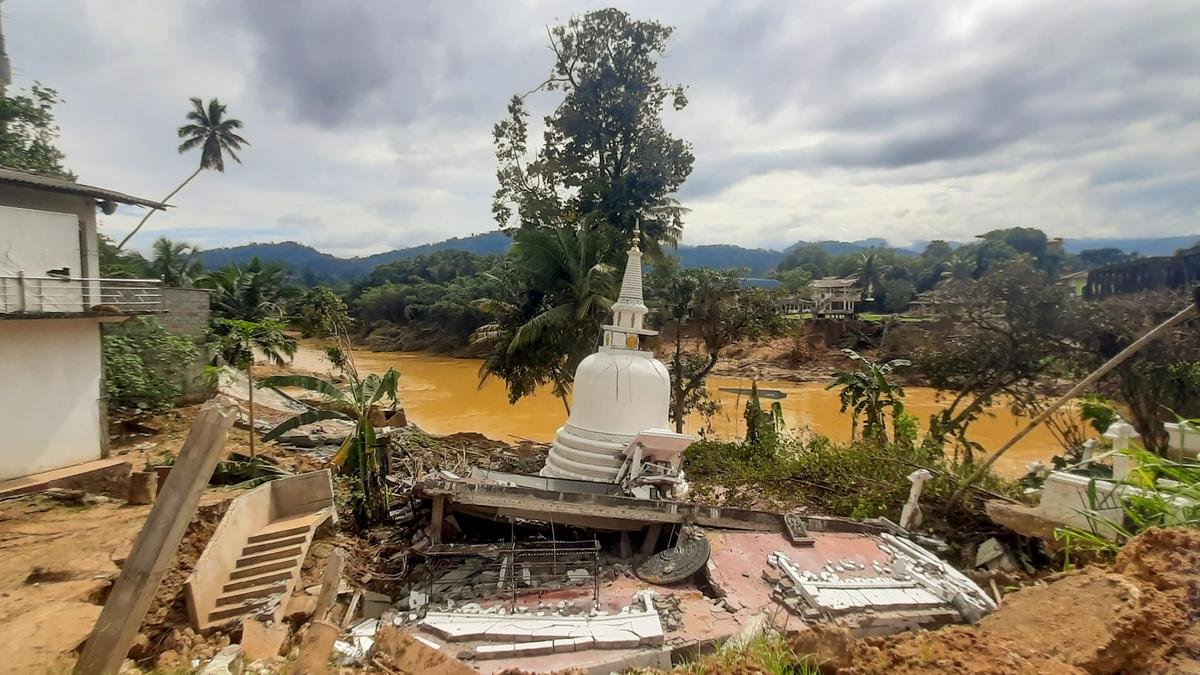
It was C. Nithsara’s first bath in 12 days. Wrapped in a white bodysuit, with large black dots marked on his forehead and cheek — believed to ward off the evil eye — the two-month-old bounced gently on his grandmother’s lap, flashing a wide grin at visitors, blissfully unaware of the storm that had destroyed his village.His family, from Rajathalawa in Sri Lanka’s Kandy district in the Central Province, has been sheltering at a Buddhist temple in a neighbouring village for nearly two weeks. They have remained there since Cyclone Ditwah struck the island in late November, bringing torrential rains, floods, and landslides. With water treatment facilities inundated in the floods, piped water for bathing and cooking is unavailable, making wells and, in some cases, rainwater the only alternative.“Our home started sliding into the earth. The floor cracked and the walls came crashing down,” says Nandika Kumari, while engaging her bubbly grandchild. “We are lucky to be alive. Eight of our relatives near our home were killed in the landslide… rescue workers have been able to recover only three bodies so far, so we held a small funeral just outside the temple.”Kandy has recorded the highest death toll from the devastating event. Of the 643 reported dead across the island so far, 237 are from this district, a popular Buddhist religious and cultural centre that draws scores of tourists every year. At least 73 are still missing in this district, as per the latest data. Some 60 families and nearly 200 people from Nandika Kumari’s village are living on the temple premises, unsure of when and where they might go, leaving behind their loved ones beneath the soil, their crushed walls and roofs, and the place they once knew as home.The remains of the dayEfforts to restore essential services are ongoing in the locality. They are compounded by the hazard of continued rain loosening the slopes further, and the difficulty of working in layers of mud, not knowing where human remains lie. Moist, brick red soil, cleared to create a narrow path through the site, lay piled in large mounds on either side, obscuring the view of the surrounding hills. Ceylon Electricity Board personnel work to provide temporary lines for power and mobile connectivity. Trapped in the earth and peeking through it are a hollowed-out autorickshaw, a damaged van, tangled wires, and a torn pink teddy bear, among other household belongings — fragments of lives once lived and livelihoods painstakingly built.A United Nations Development Programme (UNDP) assessment has found that the cyclone triggered around 1,200 landslides in Sri Lanka’s hilly interior. The Disaster Management Centre continues to issue landslide warnings amid intermittent showers.“We have been told our area is still unsafe and prone to landslides. We have been asked not to return,” says T.G Nandavati, 65, who is also staying in the temple prayer hall. She is a Sinhala speaker who picked up Tamil from neighbours in her mixed ethnicity village, and even learnt some Arabic during her years as a housemaid in West Asia. Over decades, she built a modest home with basic appliances and utensils, using savings from her four-year stint in Riyadh, her later work in the surrounding small-scale tea estates, and with contributions from her daughter, who was a domestic worker in Kuwait for 13 years. “Every single item is gone; nothing is left. But I don’t want any of those things. I am done,” says Nandavati. “We must start all over again. All I need now is a basic meal and a place to sleep.”For the cyclone-hit country, the transition from urgent rescue operations to humanitarian aid and relief, and later to long-term rebuilding, is far from easy. Families have specific yet varied needs, ranging from new homes to household appliances. Soon, they will need new jobs, along with stronger social protection and some food security, if they are to cope with the huge losses to life, property, and livelihoods.The scale of the disasterThe cyclone’s impact is visible not just in villages, but also in towns that were submerged for days. In Gampola, the once-bustling town nearest to Nandavati’s village, small businesses and traders have laid bare the toll of the devastation along the main road. Wet and damaged ware, furniture, packing material, and sacks of rice and spices lie heaped along the margins. The stench is unbearable and the monetary loss is staggering.Locals are not just overwhelmed, but also in disbelief. “I have not seen anything like this in my life,” says S.H. Adham, 80, temporarily staying at a mosque in the nearby Nawalapitiya town with other families who were evacuated amid landslide warnings. “Heavy rains and some flooding, we are used to. But not this. Something has really changed,” he says, echoing the chief concern of climate activists everywhere.Ditwah is among the worst natural disasters Sri Lanka has witnessed, with development experts warning that the response may prove more challenging than in the aftermath of the 2004 Indian Ocean tsunami. The UNDP has estimated that 2.3 million people — about 10% of Sri Lanka’s population — were living in flooded areas. Its geospatial analysis showed that floodwaters had inundated over 1.1 million hectares, almost 20% of the country’s land area, reaching nearly 7,20,000 buildings — about one in every 12.Over 300 roads and 40 key bridges have been damaged, with the Road Development Authority (RDA) reporting a loss of nearly LKR 75 billion (roughly ₹22 billion). While more than half of the power connections on the island were disrupted during the cyclone days, the Ceylon Electricity Board has flagged 40% damage to its infrastructure in the impact. Disaster Management Centre officials have enumerated close to 5 lakh affected families and 17 lakh people. Over 6,000 homes are fully damaged, and at least 1 lakh homes are partially destroyed.While the full extent of damage and loss is still being assessed, authorities continue to search for the missing, clearing routes through the rubble, reopening roads wherever possible, and building temporary bridges to connect isolated and cut-off communities. The UN aims to mobilise $35 million in grants over the next four years for the island nation which declared bankruptcy in 2022 as it could not repay its loans.
The impact of the cyclone on Gampola town in Kandy district.
| Photo Credit:
AFP
Blow after blowCyclone Ditwah is the country’s third major blow in five years. As with the COVID-19 pandemic of 2020 and the financial crash of 2022, the burden once again falls heaviest on Sri Lanka’s working-class poor, small-scale producers, and small and medium enterprises.Among them, the Malaiyaha Tamils, a community long discriminated, marginalised socially, and highly exploited in their labour, are yet again badly hit. The official death toll from the cyclone is segregated district-wise, but not according to ethnicity. However, the highest number of deaths have been reported from the Kandy, Nuwara Eliya, and Badulla districts, across the Central and Uva Provinces. These are home to scores of Malaiyaha Tamils, many of whom live and work on tea estates known to be prone to landslides. Their precarity, which has endured over the two centuries since their ancestors landed from southern India, heightens their vulnerability to shocks. Hundreds of thousands still live in overcrowded colonial-era barrack-style ‘line rooms’, where roads or water connections do not reach. Sanitation facilities are inadequate, and the access to education and health care is poor.Kalaivani* estimates she will need close to LKR 1,00,000 (about ₹30,000) to rebuild her home that was damaged in the landslide. After toiling in tea estates for 35 years, long enough to read the terrain and the yield, she sees little hope for those employed in the sector. “The tea bushes in our estate (on the outskirts of Kandy town) are not maintained well,” she says. This neglect directly impacts a worker’s daily wage, which is tied to unreasonable, or even impossible, targets. “If there are no tea leaves, we won’t be called to work. Even on the days we are called, there won’t be enough leaves for us to pluck (to meet the target in weight).”The marginal wage hike that the plantation companies previously promised remains mostly on paper for many workers. Even with their best efforts, workers are unable to meet the targets. “The President (Anura Kumara Dissanayake) has said our wages will go up from January (2026). Let us see,” says Maheswari*, another worker on a Kandy estate.But the women labourers are not holding their breath. They have heard several promises of wage hikes over the years — governments and leaders have changed, yet plantation companies remain stubbornly opposed, citing high production costs and a volatile export market. Workers, on the other hand, point to their abysmal living and working conditions, high living costs after record inflation, and growing job insecurity. Many estate workers in the area have not been called for work since the cyclone hit. Those who returned have not heard a word on compensation for the workdays lost for no fault of theirs. The concerns they voiced before the cyclone have only become more acute and urgent.The workers are tired of having to pay the price. After Sri Lanka defaulted on its external debt and declared bankruptcy in 2022, the Gotabaya Rajapaksa government made its first stop at the International Monetary Fund (IMF), a longstanding lender whose loans it had sought 16 times already. Although it is Sri Lanka’s foreign debt that is unsustainable, the IMF asked Colombo to restructure its domestic debt, which it did without a murmur. This exercise reduced the value of superannuation funds. The move hit Malaiyaha Tamil estate workers badly, with their only savings after decades of underpaid labour shrinking in final value abruptly.“We cannot return to our home because of the destruction and risk. But we have nowhere else to go,” says Danam*, 56. “Our children do not want to work on the estates any more. They want jobs in the shops in nearby towns.”With uncertainty shadowing them, young Malaiyaha Tamils are caught between a bleak present and a daunting future. To escape the difficulty at home, the men migrate within the country for low-paid service jobs. Women, meanwhile, seek domestic work abroad. Their families’ plight barely changes, even as their remittances replenish the dollars in state coffers.An arduous task aheadDays after the cyclone, President Dissanayake visited some of the most affected areas in the hill country and met communities, reassuring them of the government’s commitment to rebuilding their areas. He also directed officials to prioritise housing and livelihoods in their immediate response, apart from swift financial relief.Experts say not just estate workers, but smallholder farmers and fishers must be centred in the recovery plan for Sri Lanka, as the country may have to face questions of food security. Terming smallholder farmers and fishers the “backbone of Sri Lanka’s food system” in a recent media column, Food and Agriculture Organization representative in Sri Lanka, Vimlendra Sharan, says their rapid return to production is vital not only for their own recovery, “but also for ensuring food security and supporting rural economies.”Citing the challenge of recovery ahead, activists campaigning for economic justice are urging the government to recast its ongoing IMF programme, to secure some fiscal space to support those worst hit by the disaster. Expanding social protection and introducing a public distribution system, among other efforts, will be crucial for protecting the poorest, they contend. They also point to the structural inequality and discrimination that manifests in most affected sections’ disadvantaged location, exclusion in official communication — many early warnings were issued in Sinhala only, keeping Tamil-speakers in the dark — and inability to resume livelihoods once the cyclone passed. Every recent crisis in the country has shown that some citizens, invariably the poor, bear the cost of others’ recovery.Prior to last year’s elections, Dissanayake’s National People Power alliance made a bold pledge to renegotiate the predecessor government’s IMF deal, to reduce the pain its squeezing austerity inflicted on ordinary people. One year into power, the centre-left government has not veered away from the IMF guardrails, drawing high praise from Washington DC. The enormous losses suffered by the people in recent weeks did not prompt a single tweak in next year’s national Budget, passed in Parliament days after the cyclone made its deadly landfall. Further, Sri Lanka has sought $200 million in new borrowing from the Fund, to cope with the destruction.The ruling Dissanayake administration faces a formidable task. How it decides to rebuild, and whose lives and livelihoods it decides to foreground, will determine its own political fortune and Sri Lanka’s future. Real recovery begins when every citizen feels the cyclone has passed.Some workers’ names have been changed on request
Publicado: 2025-12-19 23:46:00
fonte: www.thehindu.com