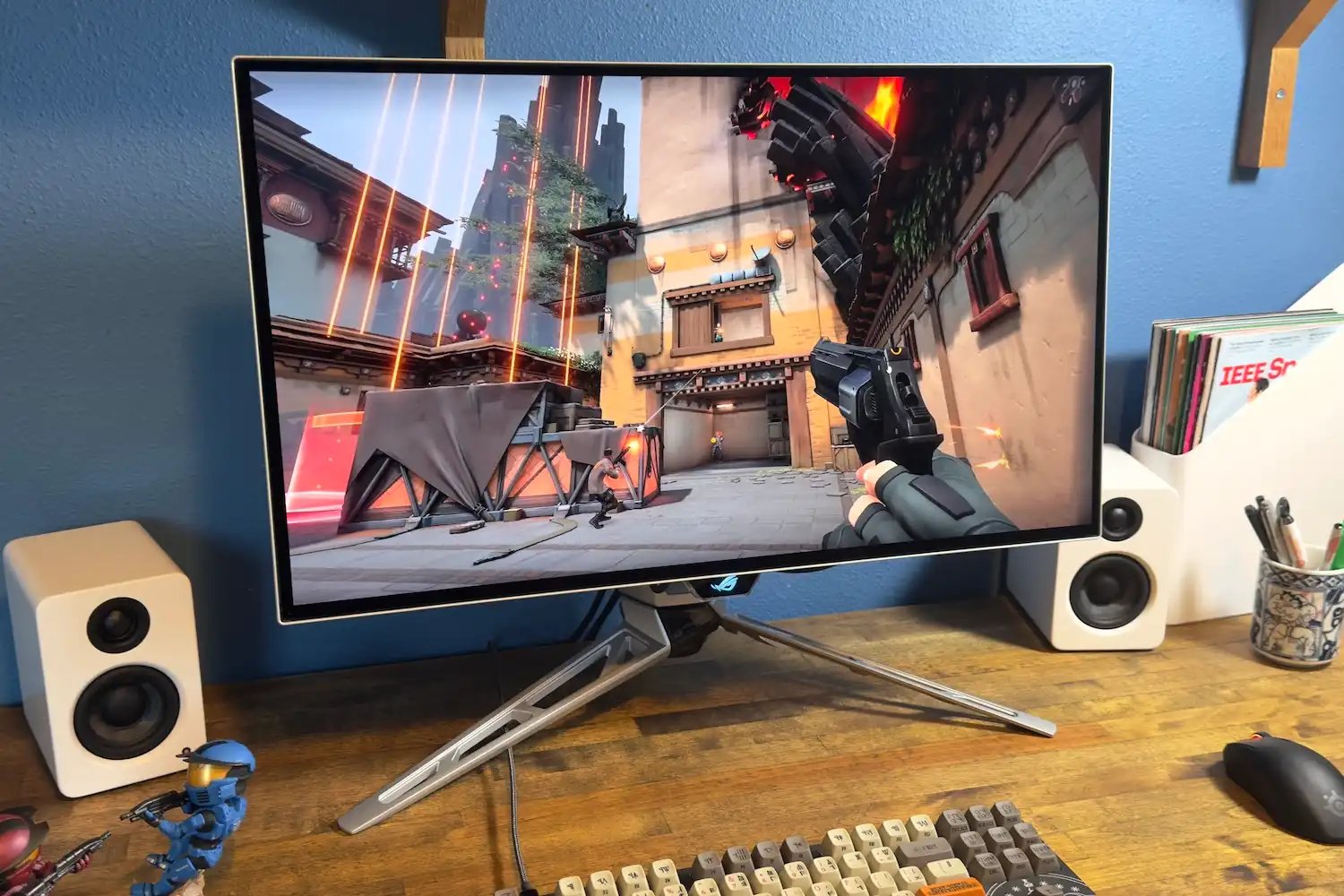
Asus ROG Swift OLED PG27AQWP-W monitor review: The apex of motion clarity

At a glanceExpert’s Rating
Pros
Attractive and unique design
Good SDR brightness for OLED, great contrast
Very wide color gamut
Great HDR performance
Sets a new high mark for motion performance
Cons
Only 1440p resolution
No USB-C or speakers
Stand is a bit large for 27-inch display
Our Verdict
The Asus ROG Swift OLED PG27AQWP-W pulls out all the stops to deliver best-in-class motion performance and a long list of bonus features.
Price When Reviewed
This value will show the geolocated pricing text for product undefined
Best Pricing Today
Best Prices Today: Asus ROG Swift Oled PG27AQWP-W
The refresh rate wars have accelerated in 2025, resulting in new records and high marks every few months. Asus’ ROG Swift OLED PG27AQWP-W continues this trend with a tandem OLED design that delivers both excellent image quality and ultra-high refresh rates—up to 540Hz at 1440p or 720Hz at 720p.
Read on to learn more, then see roundup of the best gaming monitors for comparison.
Asus ROG Swift OLED PG27AQWP-W specs and features
At its core the Asus ROG Swift OLED PG27AQWP-W is yet another 26.5-inch OLED monitor with 1440p resolution. However, this particular OLED monitor has a trick up its sleeve: a tandem OLED display. Much like Apple’s iPad Pro, it offers not one, but two OLED layers.
Asus claims this provides superior brightness and color saturation, a claim I’ll test later in this review.
Display size: 26.5-inch 16:9 aspect ratio
Native resolution: 2560×1440
Panel type: Tandem OLED
Refresh rate: 540Hz at 1440p / 720Hz at 720p
Adaptive sync: Yes, Adaptive Sync, AMD FreeSync Premium Pro, G-Sync Compatible
HDR: Yes, VESA DisplayHDR 500 True Black
Ports: 1x DisplayPort 2.1, 2x HDMI 2.1, 3x USB-A 3.2 Gen 1, 1x 3.5mm earphone jack
Audio: None
Extra features: Ergonomic stand, tripod screw mount, RGB-LED lighting with Asus Aura Sync
Price: $1099.99 retail
And that’s not all. The PG27AQWP-W is also a dual refresh monitor that can achieve up to 540Hz at 1440p resolution or 720Hz at 720p resolution. Yes, that’s 720p, as in 1280×720 resolution.
The Asus ROG Swift OLED PG27AQWP-W is set to release at $1,099.99. That’s a lot for a 1440p monitor but, given the extra tech stuffed inside, it’s not a surprise.
Asus ROG Swift OLED PG27AQWP-W design
Asus monitors typically look and feel great, but the ROG Swift OLED PG27AQWP-W goes the extra mile to deliver a unique, stand-out design. It’s mostly clad in silver but includes a transparent section on the rear of the monitor for extra flair. The internals of a monitor are actually rather dull, so you’ll mostly spy internal cladding with Asus branding. Still, I think it looks great.
Matthew Smith / Foundry
The monitor has a tripod-style stand with three legs, two of which are broad. I’m not usually a fan of these stands, as they take up extra room on a desk. That problem is still present here, but I can understand why Asus went for the tripod stand in this case. It helps complete the monitor’s design and becomes the centerpiece of your desktop gaming setup.
You’ll find that the stand offers a decent range of ergonomic adjustment. This includes 110mm of height adjustment, 60 degrees of swivel, 25 degrees of tilt, and 90 degrees of pivot for use in portrait orientation. I would like to see 130mm or even 150mm of height, but the range of adjustment available here is solid. A 100x100mm VESA mount is included for use with third-party monitor arms.
Asus packs several extra features in the PG27AQWP-W. It has an attractive RGB-LED logo that can be customized and synced with other Asus devices using Asus Aura Sync. There’s also a tripod mount on the stand, which can be used to attach a camera, ring light, or anything else compatible with a 1/4-inch tripod screw mount.
Asus ROG Swift OLED PG27AQWP-W connectivity
A total of three video inputs are found on the Asus ROG Swift OLED PG27AQWP-W: two HDMI 2.1 ports and one DisplayPort 2.1 (with up to 80Gbps of bandwidth). All three ports can handle the monitor’s maximum refresh rate (720Hz at 720p and 540Hz at 1440p).
USB connectivity includes three USB-A 3.2 Gen 1 ports, which are driven by a USB-B upstream port. A USB-C port is not available, unfortunately.
The Asus ROG Swift OLED PG27AQWP-W has a great menu system that’s controlled by a joystick tucked behind the center lower bezel. It opens an excellent menu system with easy-to-understand labels and many image quality options. The font size could perhaps be larger, but there’s decent contrast between the font and background.
This includes precise color temperature and gamma settings (i.e. a color temperature of 6500K instead of “neutral” or “standard”) and six-axis color calibration. This is an advantage over competitors such as the Alienware AW2725D and Samsung Odyssey G90F, which don’t offer as much fine-grain image quality adjustment.
Matthew Smith / Foundry
There are also a ton of gaming features stuffed into the menu system. This includes not only the usual crosshair, FPS count, and timer modes, but also features like dynamic shadow boost, which can automatically enhance the brightness of dim areas in a scene to make foes easier to see. This is superior to the more typical static shadow boost mode, which enhances brightness across the entire image, including dark areas.
I also like the aspect-ratio reduction modes, which include a 24.5-inch monitor equivalent, a 4:3 mode, and a square mode. The first is useful for some esports games, while the latter two are good options for retro games.
Most monitor options can be adjusted using the Asus DisplayWidget software, which is available for both Windows and MacOS. DisplayWidget is among the best monitor management software currently available. Some competitors, like Samsung, don’t even have a monitor management software with the same set of features. The monitor management software is generally more convenient to use than the on-screen menus controlled by the joystick.
Asus ROG Swift OLED PG27AQWP-W audio
The Asus ROG Swift OLED PG27AQWP-W does not include speakers. That’s only a minor disappointment, as many gaming monitors omit this feature. A 3.5mm audio jack is available for passing audio to a headset, at least.
Asus ROG Swift OLED PG27AQWP-W SDR image quality
The star of the show here is undoubtedly the Asus ROG Swift OLED PG27AQWP-W’s tandem OLED display. Specifically, it has two LG WOLED layers which work together to boost brightness and color volume. Contrary to what you might expect, adding a second layer doesn’t immediately double brightness or color performance, but it does provide noticeable improvements.
Matthew Smith / Foundry
First up is SDR brightness, where the PG27AQWP-W provides a maximum sustained SDR brightness of 316 nits. That is an excellent level of SDR brightness for an OLED monitor and generally bright enough for use in most rooms.
Just keep in mind that the monitor is glossy, so reflections will be an issue if you have windows or bright lights near the display. Samsung’s Odyssey OLED G60SF, which has a matte display finish and a slightly higher maximum SDR brightness, is a better OLED for use in a bright room.
Matthew Smith / Foundry
One area that tandem OLED can’t much improve is contrast, as modern OLED displays typically provide an effectively infinite contrast ratio. This occurs because they achieve a perfect minimum luminance of zero nits which, because contrast ratio is a ratio, sends the ratio into infinity.
However, perceived contrast is also worth mention. Asus takes pride in the TrueBlack Glossy finish which provides a “zero-haze surface” for maximum perceived contrast.
This is a nuanced but important point. While the OLED panel provides a minimum luminance of zero nits, ambient light that scatters across the display can reduce the perceived contrast. As a result, a matte display like the Samsung Odyssey OLED G60SF will not look as dark and contrast-rich as the PG27AQWP-W.
Personally, I prefer a matte display because I find glare distracting and I do have windows in my room that, during the day, allow enough light to cause serious reflections. However, many OLED fans prefer glossy for its superior perceived contrast—and the PG27AQWP-W is as glossy as they come.
Matthew Smith / Foundry
The PG27AQWP-W’s color gamut is important, as improved color saturation is advertised as an advantage for tandem OLED. So, does that prove true?
Yes, though perhaps not quite so much as you’d expect.
The PG27AQWP-W displayed 100 percent of sRGB, 99 percent of DCI-P3, and 93 percent of AdobeRGB in my testing. By comparison, the Asus ROG Strix XG27AQDPG, which has a modern Samsung QD-OLED panel, can display 100 percent of sRGB, 98 percent of DCI-P3, and 94 percent of AdobeRGB.
Remember, however, that the PG27AQWP-W uses tandem LG WOLED panels, which in the past have not performed as well in color gamut tests as QD-OLED. When compared to a standard LG WOLED monitor, such as the LG Ultragear 27GX790A-B, tandem WOLED is a definite upgrade (see the graph above).
While the PG27AQWP-W’s color gamut isn’t a record setter, it’s certainly excellent and up to whatever task you might throw at it.
The PG27AQWP-W is as glossy as they come.
Matthew Smith / Foundry
The same can be said of the monitor’s color accuracy. As the graph shows, the PG27AQWP-W is not the most color accurate OLED monitor we’ve recently tested. But with that said, all the OLED monitors shown in the graph above are so accurate that it’s quite hard to tell the difference. Certainly, all of them—including the PG27AQWP-W—provide a realistic and lifelike image.
Color temperature and gamma performance are good on the PG27AQWP-W. It provided a color temperature of 6400K, just off the target of 6500K, and a gamma curve of 2.3, just off the target of 2.2. Both variations are minor and typical for an OLED monitor. The PG27AQWP-W offers a wide range of color temperature and gamma adjustments, so it’s likely you can tune the monitor to your preference in each area.
Sharpness is decent. The monitor’s maximum resolution of 2560×1440 works out to about 110 pixels per inch. That’s not an amazing pixel density for 2025—a 27-inch 4K monitor will hit over 160 pixels per inch—but it’s enough to look sharp in PC games.
It’s also a good fit for an extreme high-refresh monitor. You can only appreciate the full refresh rate when a game outputs a frame rate up to the maximum refresh rate of a monitor. Sticking to 1440p makes that far more viable than at 4K due to the reduced demand on your video card (though you’re still going to need a beefy GPU).
The PG27AQWP-W’s sharpness is also improved by Asus’ Clear Pixel Edge, a feature which can slightly reduce the rough look that 1440p OLED monitors can suffer when they display small, high-contrast text. It’s not a night-and-day improvement, but it helps.
The PG27AQWP-W’s overall SDR image quality is excellent. The tandem WOLED display provides strong SDR brightness, stellar contrast, and a broad color gamut. The latest QD-OLED monitors can offer performance in the same ballpark as tandem WOLED, but the tandem WOLED panel has a small edge in DCI-P3 color gamut and SDR brightness.
Asus ROG Swift OLED PG27AQWP-W HDR image quality
Tandem OLED technology is also meant to help with brightness in HDR. The Asus ROG Swift OLED PG27AQWP-W is VESA DisplayHDR True Black 500 certified and claims a maximum brightness of up to 1500 nits.
Matthew Smith / Foundry
I wasn’t able to reach that height despite my best efforts, as I engaged the monitor’s adjustable brightness option and turned it up to the maximum.
Still, the PG27AQWP-W’s HDR performance is great overall. It measured a maximum brightness of 950 nits in the 3 percent window, which isn’t the best result I’ve seen to date. Shift your focus to the 50 percent and 100 percent windows, though—meaning, situations where a much larger portion of the display is lit—and the PG27AQWP-W creeps ahead of QD-OLED and standard WOLED alternatives.
Subjectively, I liked the PG27AQWP-W’s HDR performance. The monitor was very bright in bright scenes but also delivered good luminance detail around bright objects and excellent shadow detail in dark scenes. The color presentation is also great: vivid when it should be but not over-saturated when it shouldn’t be.
Also, as mentioned, the monitor provides a HDR brightness adjustment feature, which is not standard but very nice to have. Those less familiar with HDR might be surprised to learn that HDR content is typically given control over display brightness, which means you can’t normally adjust the brightness of your monitor when HDR is engaged. That is quite annoying on a monitor—but Asus lets you override that behavior.
Asus ROG Swift OLED PG27AQWP-W motion performance
While the tandem OLED panel is awesome, I’d argue that motion performance is at least as important. The Asus ROG Swift OLED PG27AQWP-W has a refresh rate of up to 540Hz at 2560×1440 resolution and up to 720Hz at 1280×720 resolution.
Let’s cover the 540Hz/1440p mode first. This is the way most people will use the monitor most of the time, and it looks spectacular. As I’ve mentioned in previous reviews of 480Hz and 500Hz OLED monitors, a refresh rate this high on an OLED panel looks very close to perfect and is obviously better than 240Hz or 360Hz. Nearly everything is readable as it zooms across the display, including small low-contrast text and small ticks in enemy HP bars.
Is the 540Hz noticeably better than 480Hz or 500Hz? I don’t think so. However, some 500Hz OLED monitors are priced rather close to the PG27AQWP-W. I’d buy a 480Hz or 500Hz alternative if I could save $200, but if the gap is only $100, I might lean towards the PG27AQWP-W and its 540Hz refresh rate.
What about the 720Hz/720p mode? Honestly, I’m not sure that I see the point, as I wasn’t able to notice a major motion clarity improvement in this mode. Was it very slightly better? Yes. But it comes with a big reduction in overall image sharpness.
The main argument in favor of 720Hz is latency, because a higher refresh rate means you’ll see the screen update more quickly. A 540Hz display delivers a screen update every 1.85 milliseconds, which 720Hz reduces to 1.39 milliseconds. That’s certainly less, but it’s not something I can appreciate.
The PG27AQWP-W also supports Asus’ Extreme Low Motion Blur (ELMB), and while this feature is less headline-worthy than the 720Hz/720p mode, I’d argue it’s more important.
ELMB inserts black frames between standard frames which, due to how human vision works, effectively reduces motion blur. And it’s extremely effective. The ELMB feature provides motion clarity similar to 540Hz at a refresh rate of 270Hz, which is useful, because it means you can appreciate better motion clarity in games that can’t achieve an incredibly high frame rate. Asus’ ELMB is also much better than competitive techniques from other monitor makers, with none of the “double image” effect that black frame insertion (BFI) can sometimes cause.
It does have a couple downsides, though. ELMB effectively halves the brightness of the display, since some frames will be black. Fortunately, the PG27AQWP-W is bright enough that it maintains a usable level of brightness when ELMB is turned on. ELMB also can’t be used at the same time as Adaptive Sync. Competitive BFI techniques have the same trade-offs.
Speaking of Adaptive Sync, the PG27AQWP-W supports the full range of VESA Adaptive Sync, AMD FreeSync Premium Pro, and Nvidia G-Sync. It also has an OLED anti-flicker feature to reduce the flicker that can rarely occur when using adaptive sync technologies alongside OLED monitors, or when viewing particular grayscale scenes.
The full range of the PG27AQWP-W’s motion performance can be a lot to take in, because the monitor is absolutely packed with features. What it all boils down to is simple, however: it provides the best motion clarity available from any monitor to date.
Should you buy the Asus ROG Swift OLED PG27AQWP-W?
Asus’ ROG Swift OLED PG27AQWP-W is a stunning entry into the competitive OLED monitor market. It stands out from the competition with a long list of features that are either unique to the PG27AQWP-W or work better than on competitive monitors. These features include: a tandem OLED display, 540Hz/1440p and 720Hz/720p modes, Aura Sync RGB-LED lighting, a tripod mount, and an ultra-glossy TrueBlack panel finish, among other things.
It might seem hard to justify paying $1,100 for a 1440p monitor, and to be clear, most people will be just as happy with a 4K/240Hz QD-OLED purchased at a lower price. However, the PG27AQWP-W’s tandem OLED display offers class-leading performance in several areas and a level of motion clarity that you won’t find elsewhere—not only in the 720Hz/720p mode but also at lower refresh rates.
Publicado: 2025-12-23 11:30:00
fonte: www.pcworld.com